Kinley Dorji1
1Department of Traditional Medicine, Samtse Hospital, Samtse, Bhutan
Corresponding author: Kinley Dorji, Department of Traditional Medicine, Samtse Hospital, Samtse, Bhutan
Email: kinleydorji605@gmail.com
DOI: https://doi.org/10.47811/bsj.0028070215
Copyright © 2026 Bhutan Sorig Journal published by the Faculty of Traditional Medicine, Khesar Gyalpo University of Medical Sciences of Bhutan.
This is an open access article under the CC BY-NC-ND license.

In Sowa Rigpa medicine, precious metals such as gold have traditionally been used as telpa for cauterization (tshuk) to treat various health conditions. However, due to the relatively large size of telpa, which may result in larger wounds and scarring, the Gold Needle (serkhab) is believed to have been introduced as a more precise alternative by Drungtsho Sherab Jorden in Bhutan. The needle is typically made of high-quality gold and measures approximately 6.5 cm in length and 2 mm in diameter, with a sharp tip, although variations in shape and size exist [1,2].
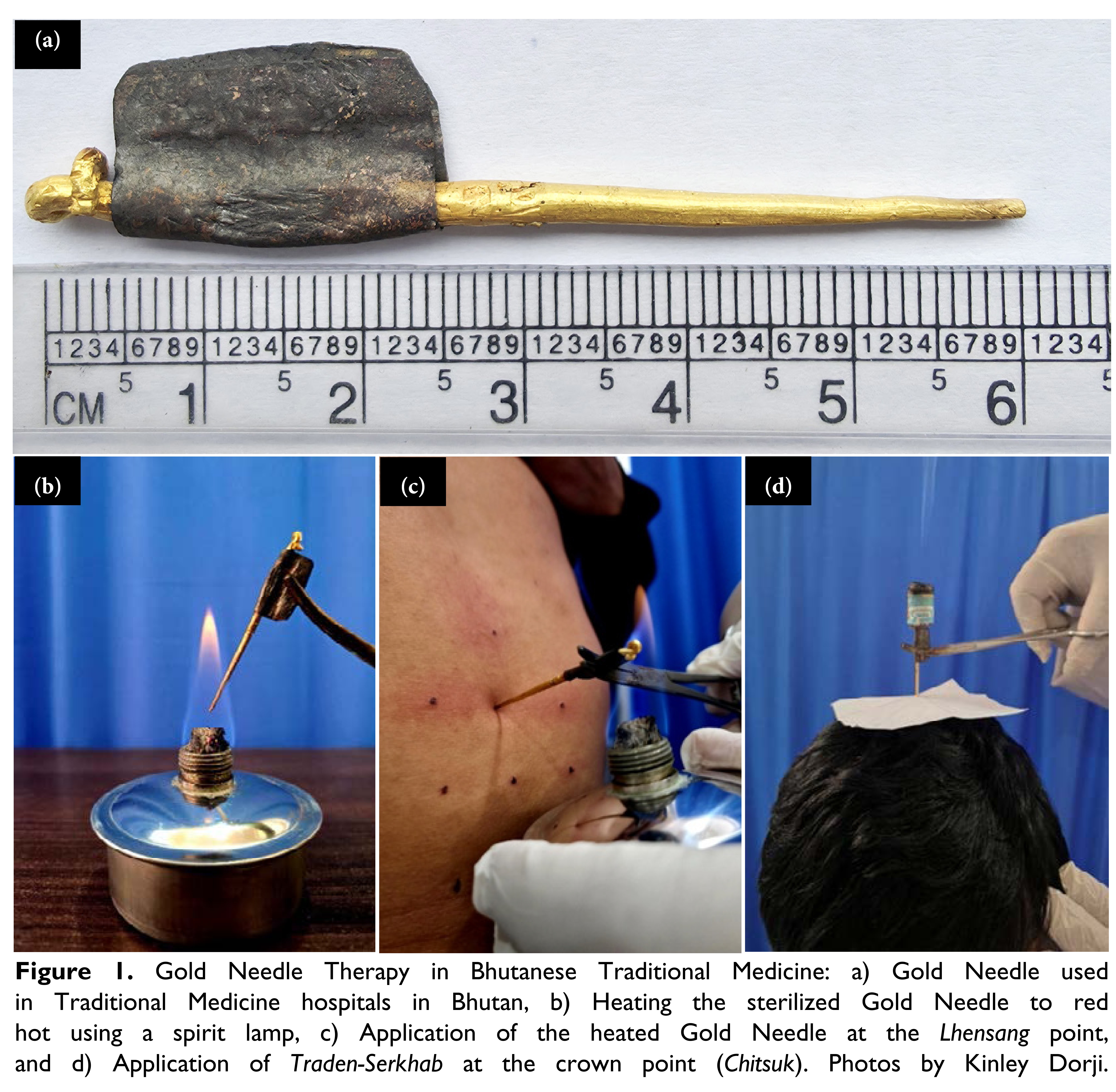
It is primarily indicated for phlegm-wind (dranglung) disorders such as indigestion, weak digestive heat, oedema, ascites, tumours, and vertigo, as well as for joint pain, skin diseases, and neurological conditions [1–3]. It may also be used in combination with moxibustion in a technique known as Traden-Serkhab, which is applied at the crown point.
In practice, the practitioner invokes the Medicine Buddha through prayer and mantra while heating a sterilised gold needle until it becomes red-hot. The needle is then placed on marked therapeutic points, with each point cauterised five times (at the point and in its four cardinal directions) at intervals approximately the size of a barley grain, to achieve an effect comparable to moxibustion and traditional telpa cauterisation [2]. Immediately following the procedure, patients are encouraged to perform a light exercise by walking a few steps. They are further advised to avoid cold drinks on the same day and to refrain from bathing for at least three days. If clinically indicated, the treatment may be repeated after one week. The therapy is avoided at certain body sites and on specific days of the lunar month, according to the movement of La (vital energy). Gold Needle Therapy remains an important modality in Bhutanese Traditional Medicine practice.
Declarations
Ethics approval and consent to participate
Not applicable
Consent for publication
Not applicable
Competing interests
The authors declares no competing interests
Funding
There was no funding for this article.
Availability of data materials
All public sources of data have been cited in this article.
Declaration of Artificial Intelligence Use
The author confirms that this manuscript was prepared, analysed, and written solely by human effort, without the assistance of generative AI or AI-based technologies.
Author contributions
Conceptualization, Validation, Investigation, Resources, Data curation,Writing – original draft, Writing – review and editing: KD
Received: 06 February, 2026 Accepted: 02 April, 2026 Published online: 14 April, 2026
References
- Arya PY. External therapies in Tibetan Medicine: The Four Tantras, contemporary practice, and a preliminary history of surgery. In: Hofer T, editor. Bodies in balance: the art of Tibetan Medicine. New York, Seattle, and London: Rubin Museum of Art in association with University of Washington Press; 2014. pp. 64–90. Available: https://www.jstor.org/content/oa_book_edited/j.ctvcwn8hk
- Department of Traditional Medicine. Chedchoe Lakdep Phendey Norbui Threngwa. 2nd ed. Wangchuk U, Dorji C, Nidup D, Ugyen K, Phuntsho U, Zangpo D, et al., editors. Thimphu: Department of Traditional Medicine Services, Ministry of Health; 2020.
- Tshenam T. Sorig Judzhi Drelchen Drangsong Zhelung. Sethroen Merig Publishing House; 2000.